
About the Whiddon College of Medicine Simulation Center
"The Whiddon College of Medicine Simulation Center is dedicated to advancing medical education and patient care by providing innovative simulation-based learning for medical students, residents, and providers."
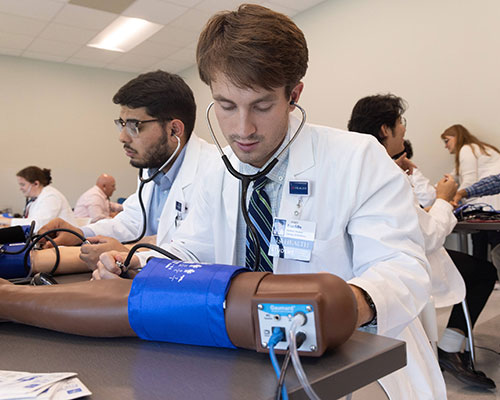 Whiddon College of Medicine Simulation Center: A Year of Growth, Impact, and Innovation
When the Whiddon College of Medicine Simulation Center officially opened in June 2024, few people knew who we were or the role we would soon play across both the Whiddon College of Medicine and the USA Health system. With only a few events in our first month, we began the work of establishing a new center focused on improving medical education through experiential learning. What started quietly has since grown into a thriving, high-impact program that is now an essential part of clinical training and patient safety preparation.
From those early days—hosting just 8 simulation events in June 2024—we expanded rapidly, reaching 66 events by April 2025. This remarkable growth reflects not only the increasing demand for simulation-based learning, but also the commitment and agility of our team to meet that need. Along the way, we’ve earned the trust of learners, faculty, and clinical teams, and have embedded ourselves in the educational fabric of both the college and health system.
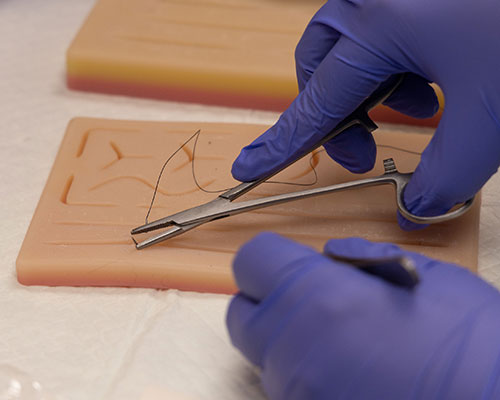 Building a Foundation for Excellence
Guided by our mission—“to advance medical education and patient care by providing innovative simulation-based learning for medical students, residents, and providers”—the Simulation Center has made a substantial impact in its first year of operation. Through close collaboration and responsive program design, we delivered over 14,000 learner hours, supporting a wide range of clinical and procedural skills development.
We supported 67 simulation events for residents and 139 clerkship sessions for medical students. In addition to the events held at the Simulation Center, we brought immersive training directly into the clinical environment, conducting 55 events at University Hospital and 42 at Children’s & Women’s Hospital. Across all programs, we facilitated 1,375 unique standardized patient encounters, with over 1,290 hours of trained facilitators guiding learners through scenarios and structured debriefings to promote critical reflection and learning.
 Enhancing Simulation Capabilities
This success would not have been possible without a strong foundation of resources. Thanks to the support of a critical HRSA grant and institutional investment from the Whiddon College of Medicine, we were able to build a cutting-edge facility equipped with high-quality simulation tools. The center features an extensive range of task trainers and procedural models covering trauma, sports injuries, joint dislocations, pelvic and breast exams, paracentesis, thoracentesis, lumbar puncture, and auscultation—many available in both adult and pediatric versions.
High-fidelity simulators further enhance the realism of our training, including six adult male simulators, two adult female birthing simulators, a pediatric model, and an infant model. Learners train with advanced diagnostic and procedural tools such as Sonosite EDGE and PX ultrasound units, Echonous Kosmos systems, Zoll R Series cardiac monitors, the Verathon Glidescope Premium, and a Respironics V6 ventilator. Together, these resources allow for comprehensive clinical scenario training that prepares learners for real-world challenges.
 Celebrating First-Year Milestones
Among our most significant achievements in the first year was earning Provisional Accreditation from the Society for Simulation in Healthcare (SSH). This distinction reflects our adherence to the highest standards in simulation-based education. Accreditation by SSH is a nationally recognized benchmark that affirms our center's commitment to safety, effectiveness, operational excellence, and continuous quality improvement. It positions the Simulation Center as a credible, high-performing program in alignment with the best practices in the field.
We also grew our team to seven full-time staff members, each contributing to the design, delivery, and support of high-impact simulation experiences. In the final quarter alone, our staff completed over 120 hours of professional development, ensuring our team remains at the forefront of simulation innovation. Our reach extended nationally, with staff attendance and participation at leading industry conferences including IMSH, Sim OPS, and ASPE.
A pivotal moment came in August 2024, when the Simulation Center officially assumed responsibility for Graduate Medical Education (GME) simulation across USA Health. This transition enabled us to design and implement tailored events that better align with residency curricula and real-world clinical challenges, strengthening our connection to training programs and clinical leaders across the system.
Looking Ahead
As we reflect on our first year, we look forward to continued growth and strategic development. In alignment with our vision—“to be a regionally recognized leader in simulation-based medical education, advancing patient care through excellence in teaching, service, innovation, and research”—we are committed to expanding our educational impact and deepening partnerships across our institution.
Our priorities for the coming year include strengthening our collaboration with the GME community by developing new resident-focused events and expanding our offerings to address specialty-specific needs. We also plan to grow our in-situ simulation program—bringing realistic, team-based training into the clinical environments of USA Health hospitals to reinforce readiness, teamwork, and systems-based practice. Additionally, we aim to increase interprofessional simulation initiatives, launch targeted faculty development opportunities, and advance simulation-based research and quality improvement projects that enhance patient outcomes.
The first year of the Whiddon College of Medicine Simulation Center has been defined by momentum, innovation, and purpose. With a strong foundation in place and a bold vision for the future, we are excited to continue leading the way in healthcare education through immersive, impactful simulation.