
Bay Watch
Posted on June 15, 2026 by Alumni Department
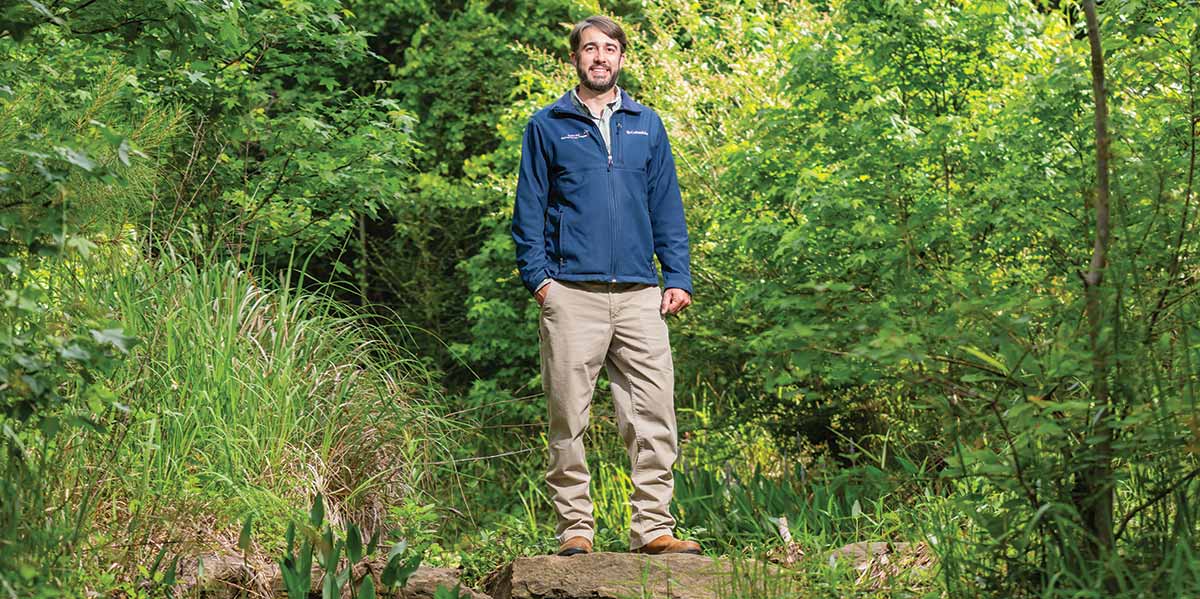
When Jason Kudulis ’06 looks toward the Gulf Coast, he sees a delicate balance between its natural beauty and increasing development. As the new director of the Mobile Bay National Estuary Program, Kudulis is tasked with managing that tension.
His primary tools are a newly approved 10-year comprehensive conservation and management plan and the first major assessment update in 18 years to the State of Alabama’s Estuaries and Coast Report.
Both arrive at a critical juncture: In the last two decades, the region has weathered a historic oil spill, intensifying hurricanes and an influx of new residents.
“People want to move here, and I don’t blame them,” says Kudulis, who has been with the program for nearly 10 years. “But as they do that, we’re seeing repercussions from the past 20 years of growth that we’re trying to manage. It’s a mindset of, ‘How can we minimize our impact so we’re not compounding and intensifying them over the next several decades?’”
The Mobile Bay National Estuary Program, funded and guided by the U.S. Environmental Protection Agency, is one of 28 such programs around the country that aim to protect and restore water quality, restore natural habitats and maintain ecological integrity in the region’s estuaries. It comprises government, industry, nonprofit organizations and academia, including USA faculty.
To safeguard an estuary fed by one of the nation’s largest freshwater inflow systems, Kudulis draws on his education, including a bachelor’s degree in geography from South, and years of outdoor experience in the National Park Service. He doesn’t see science, preservation and protection as foils to growth and industry. Instead, he takes a holistic view, believing that everyone has a place at the table. Even before he started his position in February, he was hyperaware that every rooftop, strip mall, parking lot and industrial site in the region poses a challenge for the bay and surrounding waters. With the annual economic value of Alabama’s coastal resources measured in billions of dollars, he’s protecting the foundation of the region’s prosperity and preserving its natural assets at the same time.
“If we turn that spigot off, not just financially but in the way we’re managing things, that’s going to be a disservice. We’ve got to keep our foot on the gas of continuing to identify stressors and make decisions using the best available data to tackle them,” Kudulis says.
-
The Art of Medicine
Dr. Jeffery S. La Rochelle, the new dean of the Frederick P. Whiddon C...
June 17, 2026 -
Base Camp
South to scale up support with new military services home....
June 17, 2026 -
Flagship Futures
One of the newest scholarship programs at the University of South Alab...
June 17, 2026 -

Estuary of Innovation
The Frederick P. Whiddon College of Medicine building, opening in spri...
June 17, 2026